Topic 1Crystallization of the amorphous drug in dry dispersions1 of 15
A few percent of PVP, HPMC or HPMCAS lowers dry nucleation of amorphous felodipine about a hundredfold, all three alike.
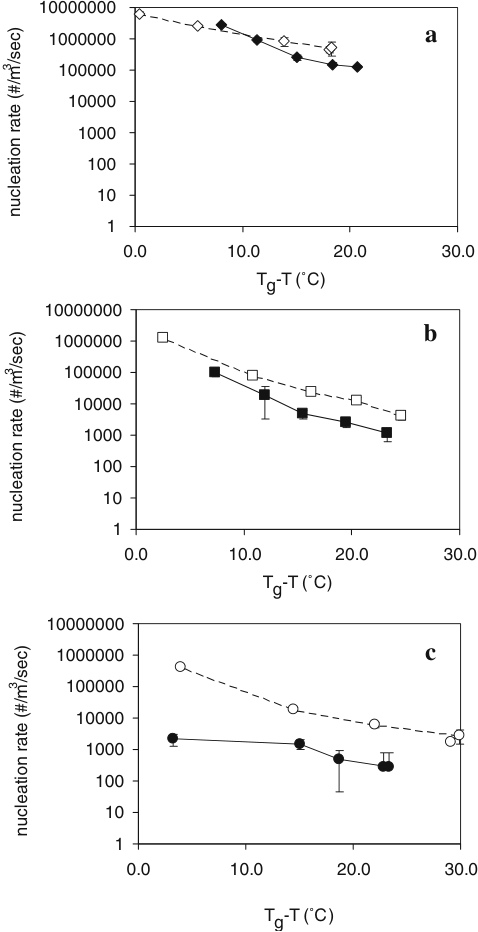
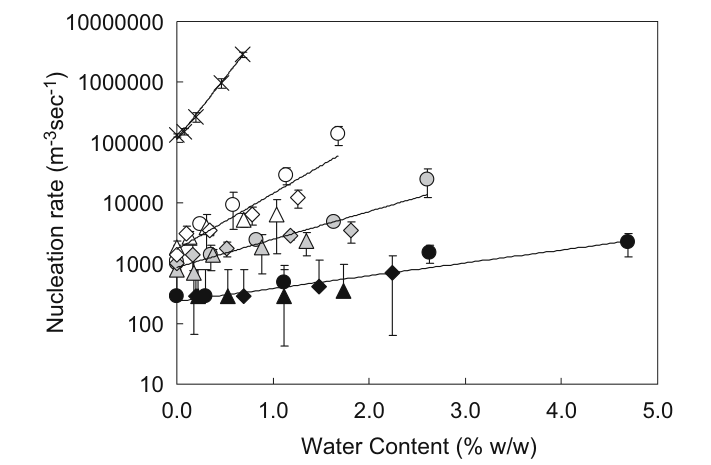
Felodipine with 0–25% w/w polymer was spin-coated as thin films, stored dry (0% RH) at 22 °C, and nucleation sites (birefringent crystal nuclei seen under polarized light) were counted over time konno2006 P1, P2, E1. The nucleation rate fell from about 1.3 × 10⁵ m⁻³ s⁻¹ for the drug alone to about 2–3 × 10³ with 3% polymer, and 25% PVP gave only about one decade more konno2006 R4, C13. At every content the three polymers gave the same rate "within experimental error" konno2006 C14.
moderateModerate: the drop is large against triplicate error bars, but the equality of the polymers rests mostly on 3–15% polymer with wide scatter on a log axis, and absolute rates of the same system differ about fourfold between papers konno2006 K1, K2, X9; marsac2006a X1.
The first 3% removes a 40–60-fold factor and the next 22% about one decade more; from 3 to 15% the three polymers lie within about 1.5-fold of each other. konno2006 R4, R4.a, R4.b, R4.g, X9
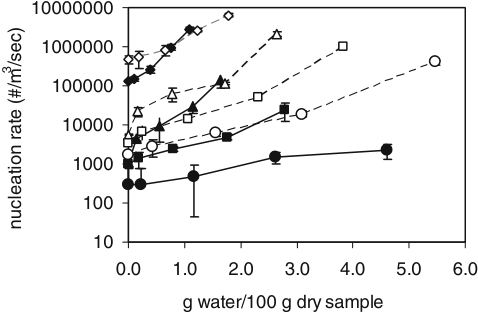
Both drugs drop about two orders of magnitude at 7 wt% PVP and only 3–4-fold further up to 25 wt%. marsac2006a R16, C18, C19
For your drug
- Count nucleation sites in dry spin-coated films of the neat amorphous drug and with 3, 7 and 15% of each candidate polymer at one storage temperature below Tg.
- A drop of one to two decades at 3–7% followed by a flat curve, with the polymers within about twofold of each other, matches the felodipine pattern; repeat at the storage humidity before choosing a polymer.
How it works and key numbers
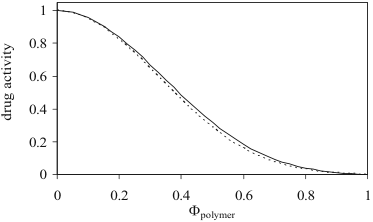
- A lower driving force through mixing "probably cannot account" for the drop: Flory–Huggins theory with data for comparable systems predicts little change in drug activity below a polymer volume fraction of about 0.5 konno2006 C34, C35, R20.
- A pure dilution effect would scale with the polymer fraction; a 3% addition giving a 1.5-order drop rules it out ("clearly not the case") konno2006 C37.
- "It seems reasonable to speculate" that the polymers raise the kinetic barrier to moving molecules onto the nucleus, possibly through polymer rejected by the growing nucleus and piling up at its surface konno2006 C39, C40, C41.
- With 3% PVP the nucleation activation energy of felodipine below Tg rose from 145 to 201 kJ/mol, which the authors read as a higher barrier ("it appears"); neither the barriers nor the polymer at the nucleus surface were measured (see F4) marsac2006a R3, C20, C48; konno2006 X14.
Connections to other chapters
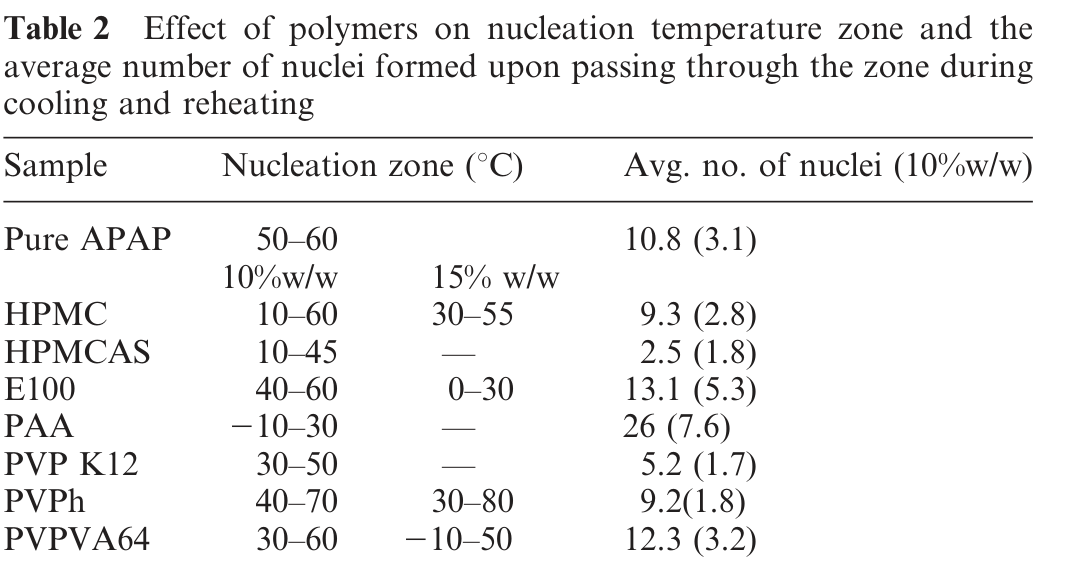
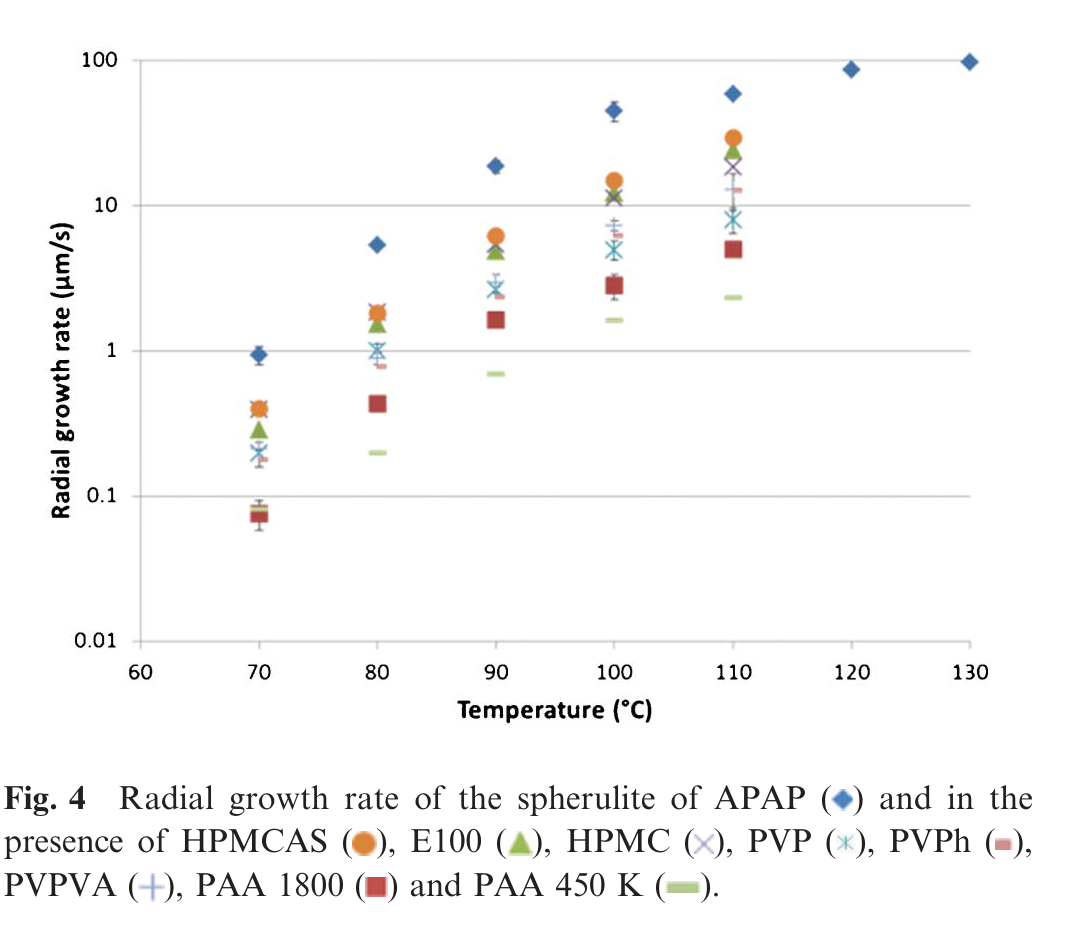
Nucleation windows are separate from growth windows in neat drugs, acetaminophen nucleating only at 50–60 °C while its growth was measured at 70–110 °C trasi2012a C22, R6, and a few percent polymer acts on nucleation, 3% lowering felodipine nucleation from about 1.3 × 10⁵ to 2.3–3.0 × 10³ m⁻³ s⁻¹ konno2006 R4.
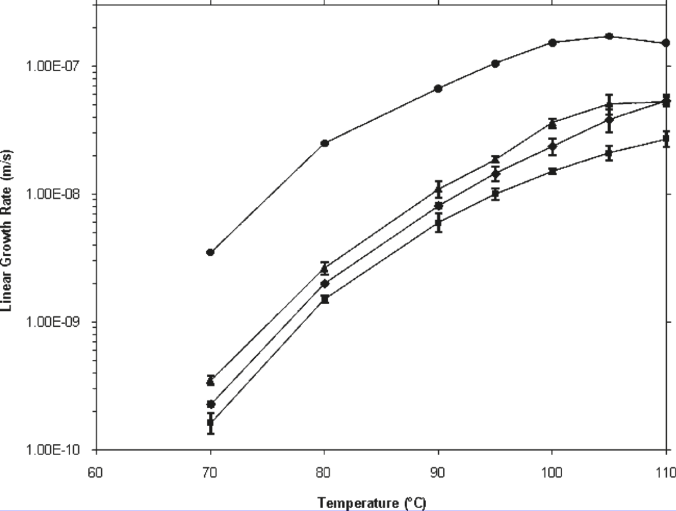
Dry nucleation of felodipine was equal for PVP, HPMC and HPMCAS within error konno2006 C14, whereas melt growth was ordered PVP > PVP/VA > HPMCAS > PVAc kestur2010a R6.
conditions differ PEG dispersions F9: A crystal of PEG can seed drug crystals: ibuprofen and fenofibrate crystallize at its surface within minutes.
Amorphous polymers lowered the nucleation of felodipine by 1.5 orders of magnitude at 3% konno2006 C13, C37, while crystalline PEG nucleated ibuprofen and fenofibrate at its interface zhu2012 R15, R19.
2 more connections
A polymer lowers nucleation by about two orders of magnitude at a few percent marsac2006a R16, C18, where it lowers melt growth by about 3–14-fold trasi2014a R6, X6.
Dry nucleation was equal for the three polymers konno2006 C14, while the spin-coated screen gave different mean amorphicity indices (PVP and PVPVA 70, HPMCAS 62, PAA 49) vaneerdenbrugh2010b R5.
Evidence: data, conditions and papers
Finding F1. A few percent of PVP, HPMC or HPMCAS lowers the dry nucleation rate of amorphous felodipine and nifedipine by about two orders of magnitude, more polymer adds little, and the three polymers do not differ when dry
In short. In dry spin-coated films at 22 °C, amorphous felodipine nucleated at about 1.3 × 10⁵ m⁻³ s⁻¹ alone and at about 2–3 × 10³ m⁻³ s⁻¹ with 3% w/w PVP, HPMCAS or HPMC, "around 1.5 orders of magnitude" lower, while 25% PVP gave only about one decade more (about 3 × 10²) konno2006 R4, C13. At every content the three polymers gave the same rate "within experimental error" konno2006 C14. PVP lowered the nucleation of both felodipine and nifedipine by about two orders of magnitude at 7 wt% and only 3–4-fold further up to 25 wt% marsac2006a R16, C18, C19, and the dry pattern was found again as the baseline of the two moisture studies konno2008 R1, C9; marsac2008a R1, C8.
Type. observation in 2 drugs and 3 polymers Strength. the drop is large against triplicate error bars (konno2006 K1: strong), but "equally effective" rests mostly on 3–15% polymer with wide scatter on a log axis (konno2006 K2: moderate; X9), and the absolute rates of the same system differ about fourfold between papers (marsac2006a X1).
How it was shown
Konno and Taylor (2006) spin-coated felodipine with 0–25% w/w PVP K29/32, HPMCAS or HPMC, stored the films at 0% RH and 22 °C, and took the nucleation rate as the slope of birefringent site density against time, each composition in triplicate konno2006 P1, P2, E1, A2, R18. Marsac, Konno and Taylor (2006) used the same method for nifedipine and felodipine with 0–25 wt% PVP K29/32 marsac2006a P1, P4, A2.
What the data show
The first 3% of polymer removed roughly a 40–60-fold factor (synthesis: 1.3 × 10⁵/3.0 × 10³ = 43 for PVP), and the next 22% about one decade more konno2006 R4.a, R4.b, R4.g. From 3 to 15% the three polymers lay within a factor of about 1.5 of each other konno2006 R4, X9.
| paper | system and conditions | result | ids |
|---|---|---|---|
| konno2006 | felodipine with PVP, HPMCAS or HPMC, films, 0% RH, 22 °C, n = 3 | ≈1.3 × 10⁵ alone; ≈2.3–3.0 × 10³ at 3%; ≈3 × 10² m⁻³ s⁻¹ at 25% PVP; polymers equal within error | konno2006 R4, C13, C14 |
| marsac2006a | nifedipine and felodipine with PVP K29/32, 0% RH | ≈1.2 × 10⁵ → 1.4 × 10³ (nifedipine) and ≈3 × 10⁴ → 2.7 × 10² m⁻³ s⁻¹ (felodipine) at 7 wt%; 3–4-fold more to 25 wt% | marsac2006a R16, C18 |
| marsac2008a | same pair, dry baseline | felodipine 1.4 × 10⁵ → 1.1 × 10³ (7% PVP) → 3 × 10² (25% PVP); nifedipine 4.7 × 10⁵ → 5.6 × 10³ → 1.7 × 10³ m⁻³ s⁻¹ | marsac2008a R1.a, R1.b, R1.f, R1.g, R1.h, R1.l |
| trasi2012a | acetaminophen melt with 10% w/w of seven polymers, one cooling–reheating cycle | nuclei: 10.8 alone; 2.5 (HPMCAS), 5.2 (PVP), 26 (PAA) | trasi2012a R12, C46 |
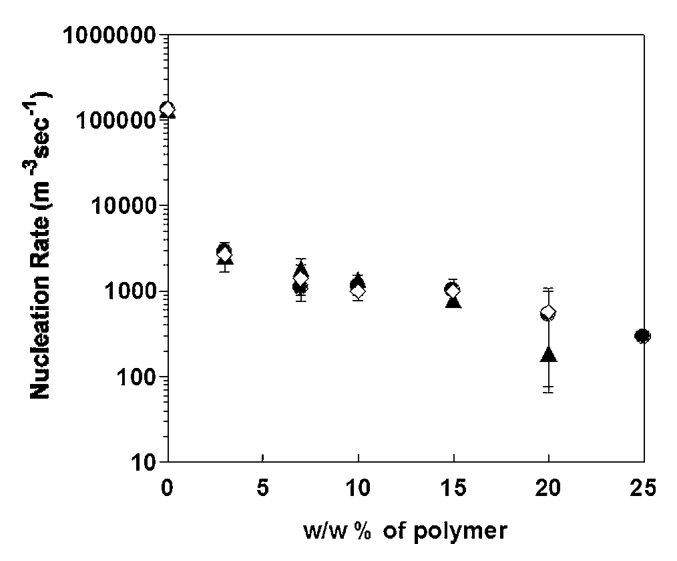
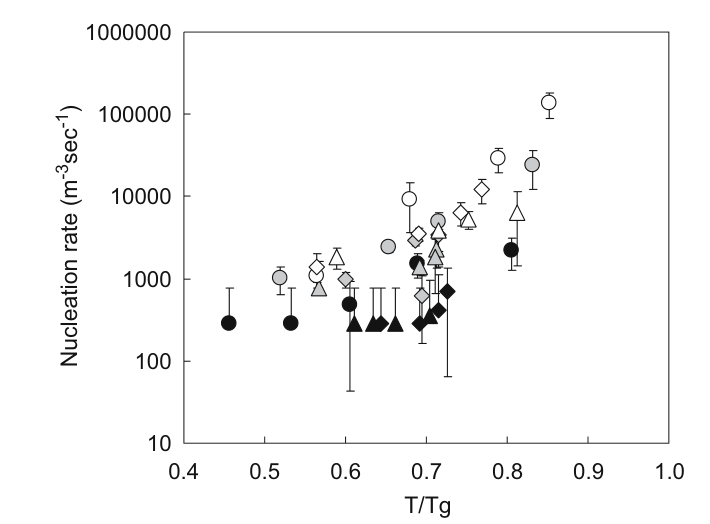
On the log axis the drug-alone point sits about 50-fold above every 3% point, and the three symbols overlap at most levels konno2006 R4, X9.
Why
A lower driving force through mixing "probably cannot account" for the drop, and a pure diluent effect, which would scale with polymer fraction, is ruled out by a 1.5-order drop at 3% konno2006 C34, C35, C37. "It seems reasonable to speculate" that the polymers increase the barrier to moving molecules onto the nucleus, possibly through rejected polymer piling up at its surface konno2006 C39, C40. This barrier was not measured konno2006 X14.
Limits and transfer
Dry thin films at 22 °C and two dihydropyridine drugs konno2006 P1, P2; marsac2006a P1, P4. Equality holds for nucleation and only when dry: at 33–75% RH the three polymers separated, PVP being weakest at low content (F11) konno2008 C10. Count nucleation sites in dry films of the neat drug and with 3, 7 and 15% of each candidate polymer, then repeat at the storage humidity before choosing a polymer.
How it was shown
Konno and Taylor (2006) asked whether a polymer's ability to slow nucleation of a molecularly dispersed amorphous drug follows the Tg it gives the dispersion or its hydrogen bonding with the drug konno2006 C6. Felodipine and PVP K29/32, HPMCAS (AQOAT AS-MF) or HPMC (Pharmacoat 606) were dissolved in dichloromethane:ethanol 1:1, spin-coated at about 2500 rpm in a nitrogen glove box below 10% RH, heated briefly to 90 °C and stored over phosphorus pentoxide (0% RH) at 22 °C konno2006 P1, P2, M2, M3, M4. Birefringent nucleation sites were counted under polarized light in 12 areas per film with a 10× objective, converted to a volume density with the depth of field of the objective (0.0144 mm), and the nucleation rate was taken as the slope of site density against time; sites at the film edge were excluded and each composition was run in triplicate at 0, 3, 7, 10, 15, 20 and 25% w/w polymer konno2006 P2, E1, A2, R18. Marsac, Konno and Taylor (2006) used the same film and counting method for nifedipine and felodipine with 0–25 wt% PVP K29/32 marsac2006a P1, P4, A2. Konno and Taylor (2008) reproduced the 2006 dry rates as the 0% RH panel of their moisture study, and Marsac and co-workers (2008) measured both drugs again at 0% RH with 7–25 wt% PVP konno2008 R1, X10; marsac2008a R1, P1, P3.
What the data show
Felodipine alone nucleated at about 1.2–1.35 × 10⁵ m⁻³ s⁻¹; 3% polymer gave about 2.3–3.0 × 10³, 7% about 1.1–1.8 × 10³, 15% about 0.75–1.1 × 10³, 20% about 1.8–5.7 × 10² and 25% PVP about 3 × 10² konno2006 R4. The first 3% therefore removed roughly a 40–60-fold factor (synthesis: 1.3 × 10⁵/3.0 × 10³ = 43 for PVP and 1.2 × 10⁵/2.3 × 10³ = 52 for HPMCAS), and the next 22% about one decade more konno2006 R4.a, R4.b, R4.g. From 3 to 15% the three polymers lay within a factor of about 1.5 of each other; at 20% HPMCAS sat about threefold lower inside error bars spanning about 70 to 1.05 × 10³, and at 25% only the PVP point was plotted konno2006 R4, X9. In the PVP study nifedipine fell from about 1.2 × 10⁵ to 1.4 × 10³ m⁻³ s⁻¹ at 7 wt% PVP and to 4.3 × 10² at 25 wt%, felodipine from about 3 × 10⁴ to 2.7 × 10² and 7 × 10¹ marsac2006a R16. The 2008 dry baseline gave felodipine 1.4 × 10⁵ → 1.1 × 10³ (7% PVP) → 3 × 10² (25% PVP) and nifedipine 4.7 × 10⁵ → 5.6 × 10³ → 1.7 × 10³ m⁻³ s⁻¹ marsac2008a R1.a, R1.b, R1.f, R1.g, R1.h, R1.l.
| paper | system | method and conditions | result | ids |
|---|---|---|---|---|
| konno2006 | felodipine with PVP, HPMCAS or HPMC, 0–25% w/w | spin-coated films, 0% RH, 22 °C, site counts, n = 3 | ≈1.3 × 10⁵ alone; ≈2.3–3.0 × 10³ at 3%; ≈3 × 10² at 25% PVP (m⁻³ s⁻¹); polymers equal within error | R4, C13, C14 |
| marsac2006a | nifedipine and felodipine with PVP K29/32, 0–25 wt% | same method, 0% RH | ≈1.2 × 10⁵ → 1.4 × 10³ (nifedipine) and ≈3 × 10⁴ → 2.7 × 10² (felodipine) at 7 wt%; 3–4-fold more to 25 wt% | R16, C18 |
| konno2008 | felodipine with the three polymers, dry | 2006 data reproduced | ≈0.8–2.9 × 10³ at 3–15% for every polymer; "very little difference" | R1, C9, X10 |
| marsac2008a | nifedipine and felodipine with PVP, dry | spin-coated films, 0% RH | 7% PVP cut the rate about two orders of magnitude; further PVP lowered it gently | R1, C8 |
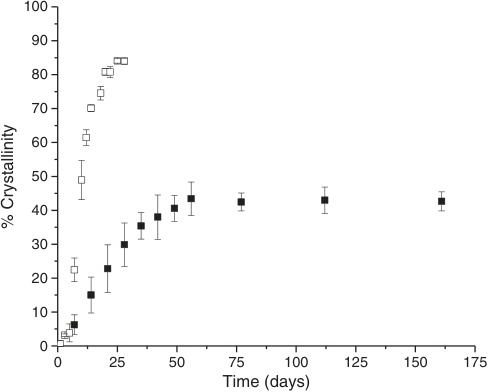
| kestur2013b | felodipine powders with 3 wt% PVP K-29/32, 30 °C, dry | early slope of PXRD crystallinity against time | 60–77-fold slower than the neat glass; a cited 150-fold drop of nucleation at 30 °C | R15, R22 |
| trasi2012a | acetaminophen melt with 10% w/w of seven polymers | nuclei after one cooling–reheating cycle, hot stage, n = 5 | 10.8 alone; 2.5 (HPMCAS), 5.2 (PVP), 26 (PAA), 9.2–13.1 for the others | R12, C46 |
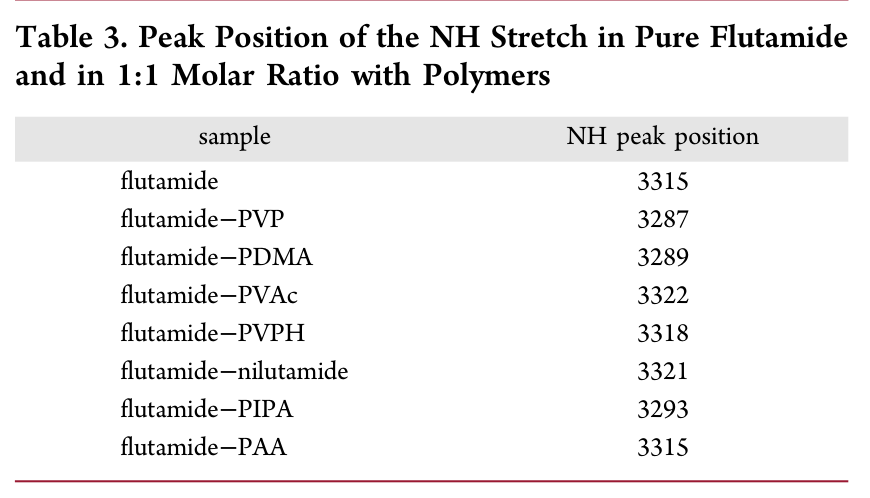
| trasi2012b | flutamide melt with 10 mol% of five polymers | growth rate at the DSC exotherm maximum, n = 2 | lower nucleation with PVAc and PIPA only; no significant effect of PDMA, PVPH, PVP | R11, C18 |
| kestur2010a (outside) | felodipine melt growth with 3% w/w PVP, PVP/VA, HPMCAS, PVAc | hot-stage growth at 70–110 °C | growth, unlike nucleation, ranked the polymers: about 10-, 7- and 4-fold slower and no effect at 70 °C | R6, R7, X2 |
Figure
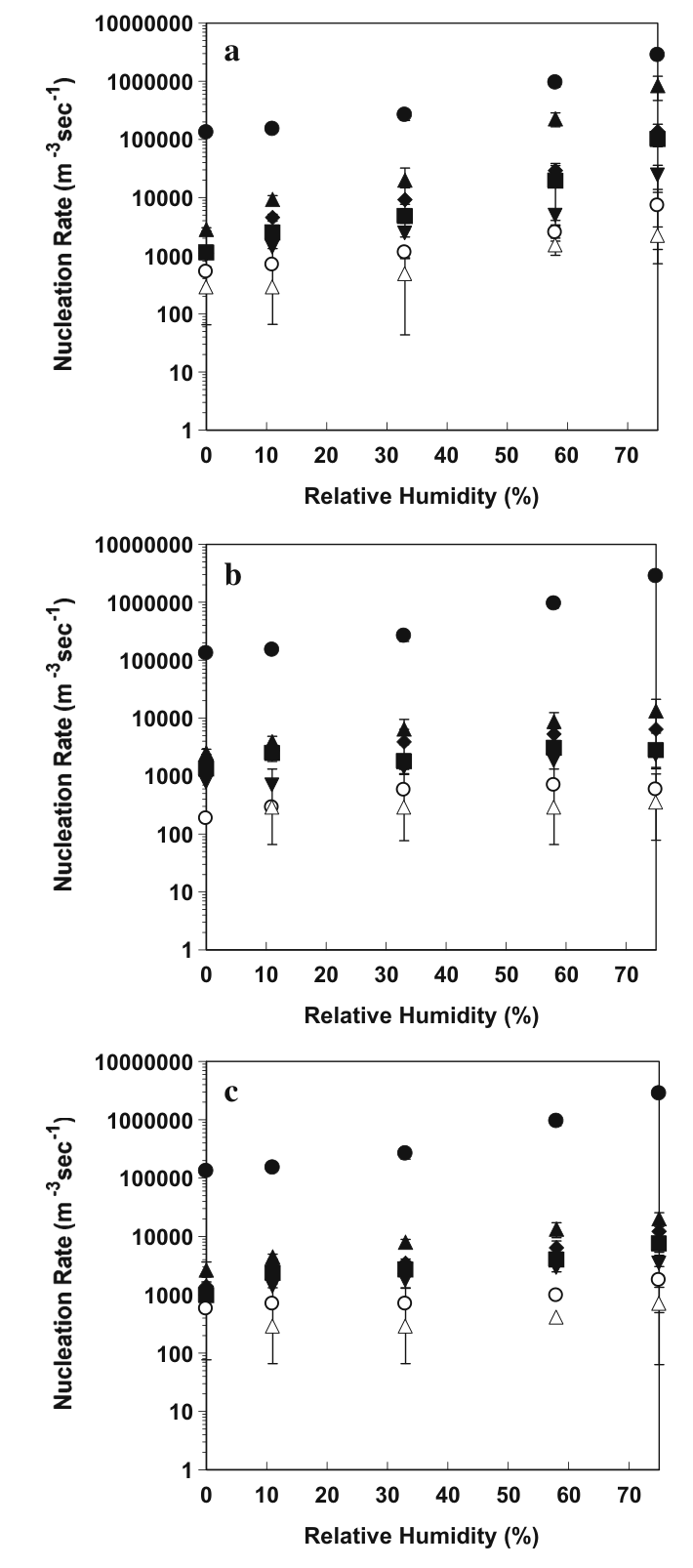
On the log axis the drug-alone point sits about 50-fold above every 3% point, and the three symbols (filled circle PVP, triangle HPMCAS, open diamond HPMC) overlap at most levels; at 25% only PVP is visible konno2006 R4, X9.
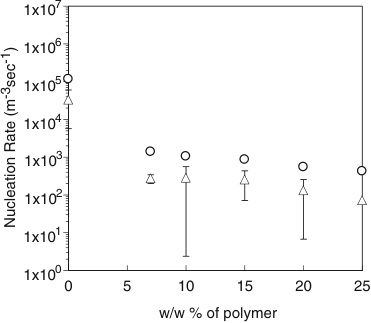
Both drugs drop about two orders of magnitude at 7 wt% PVP, and nifedipine (circles) stays above felodipine (triangles) at every level marsac2006a R16.
Why
The authors' account, with their hedges: three candidate effects of the polymer were weighed. A lower driving force through mixing "probably cannot account" for the drop, because Flory–Huggins theory with data for comparable systems predicts little change in drug activity below a polymer volume fraction of about 0.5 konno2006 C34, C35, R20. A pure diluent effect would scale with polymer fraction, and a 3% addition giving a 1.5-order drop rules it out ("clearly not the case") konno2006 C37. What remains is a raised kinetic barrier: "it seems reasonable to speculate" that the polymers increase the barrier to moving molecules onto the nucleus, possibly through polymer rejected by the growing nucleus and piling up at its surface, and after the first large drop the effect "appears" set by the amount of polymer rather than its type konno2006 C39, C40, C41. In the PVP study the nucleation activation energy below Tg rose with 3% PVP, significantly for felodipine (145 to 201 kJ/mol), which the authors read as a higher barrier ("it appears") marsac2006a R3, C20, C48. None of these barriers, nor the polymer at the nucleus surface, was measured (see F4) konno2006 X14. (synthesis: the flat part above about 7% is what a barrier saturating with polymer at the interface would give, but the papers do not test this.)
Conditions and limits
Dry storage (0% RH) at 22 °C, thin spin-coated films heated to 90 °C, 3–25% polymer, two dihydropyridine drugs konno2006 P1, P2; marsac2006a P1, P4. Rates are counts per depth-of-field volume and comparable only within a counting method; the 2006 conversion is described as multiplication where division is meant, and absolute rates differ about fourfold between Table II and the figures of the PVP study konno2006 X6; marsac2006a X1, X10. Between papers the felodipine-alone rate is about 3 × 10⁴ in Fig. 9 of marsac2006a but 1.3–1.4 × 10⁵ in the other three papers (synthesis: about fourfold) marsac2006a R16.a; konno2006 R4.a; marsac2008a R1.g. Growth was not measured in these studies konno2006 X14.
Counterexamples and conflicts
Equality holds for nucleation and only when dry: at 33–75% RH the three polymers separated, PVP being weakest at low content (F11) konno2008 C10. For melt crystal growth of felodipine at 3% polymer the polymers differed several-fold (PVP > PVP/VA > HPMCAS > PVAc), so "polymer type does not matter" does not carry over from nucleation to growth kestur2010a R6, R7; konno2006 C14. Across drugs no polymer was best for all (see Miscibility and drug-polymer interactions F15). Nor does the equality carry over to other drugs: in supercooled acetaminophen with 10% w/w polymer the number of nuclei per cooling–reheating cycle ranged tenfold, from 2.5 with HPMCAS to 26 with PAA against 10.8 for the drug alone, and in flutamide two of five polymers lowered nucleation while the others had no significant effect (see F17) trasi2012a R12, C46; trasi2012b R11, C18. (synthesis: the felodipine result of 2006 is therefore a result for one drug in thin films at 22 °C, not a rule for polymers.) A later paper cites the 2006 study for a 150-fold drop of felodipine nucleation with 3% PVP at 30 °C kestur2013b R22, larger than the 40–60-fold drop read from the 2006 rates at 22 °C (synthesis: 1.3 × 10⁵/3.0 × 10³ = 43 konno2006 R4); the 2006 card holds no rates at 30 °C, so the cited value cannot be checked here.
Transfer check
Count nucleation sites in dry spin-coated films of the neat amorphous drug and with 3, 7 and 15% of each candidate polymer at one storage temperature below Tg. A drop of one to two decades at 3–7% followed by a flat curve, with the polymers within about twofold of each other, puts the drug in the felodipine pattern. Repeat at the storage humidity before choosing a polymer, since equal dry behaviour hid a 30–70-fold difference at 75% RH (synthesis: 8.6 × 10⁵/1.3 × 10⁴ = 66 and 8.6 × 10⁵/2.0 × 10⁴ = 43 at 3% konno2008 R3.b).
History
Matsumoto and Zografi (1999, outside the library) had seen PVP inhibit indomethacin crystallization at levels too low to raise Tg, which framed the 2006 question konno2006 C3, R21. Konno and Taylor (2006) first measured the polymer effect on nucleation in the library and found the three polymers equal when dry konno2006 C14; Marsac and co-workers (2006) confirmed the same two-decade drop for nifedipine and felodipine with PVP marsac2006a C18. In 2008 both groups used the dry state as the reference for adding water and found the equality lost in humid air konno2008 C9, C10; marsac2008a C8, C9. Later in the library a polymer was found to cut melt growth rates by a broadly similar factor for fast and slow growers (see Crystallization tendency F19). In 2012 Trasi and Taylor counted nuclei in supercooled acetaminophen and flutamide with several polymers and found the polymers far from equal, and in opposite order to their effect on growth for acetaminophen trasi2012a C46, C53; trasi2012b C45; in 2013 Kestur and co-workers read the 60–77-fold slower crystallization of felodipine powders with 3% PVP as mainly a nucleation effect kestur2013b C36 (see F17).