Topic 1Phase behaviour of drug–PEG mixtures1 of 4
Drugs dissolve in molten PEG to very different degrees, from almost nothing to about 40 wt% drug.
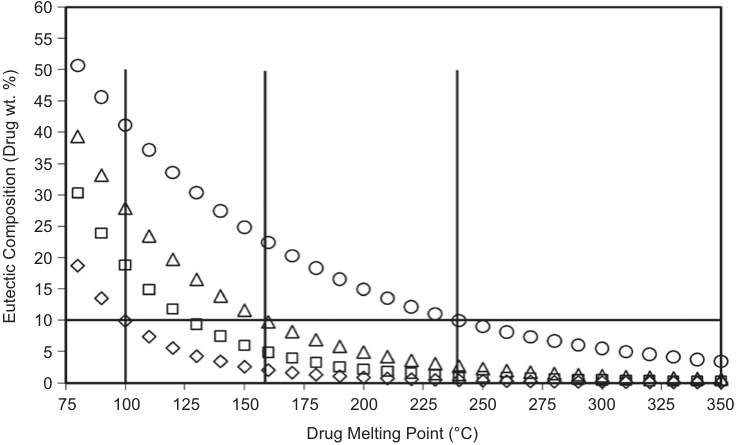
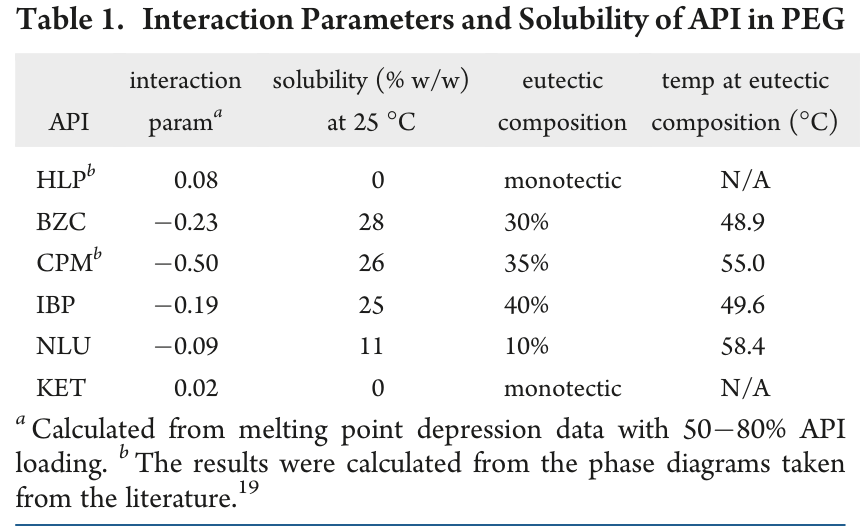
Mixtures of nine drugs with PEG 3350 were melted and their melting behaviour followed from 0 to 100 wt% drug. The eutectic composition (the maximum drug solubility in molten PEG at the lowest melting temperature) was below 1 wt% for haloperidol, which barely dissolves (monotectic), and 30–40 wt% for chlorpropamide, aceclofenac, benzocaine and ibuprofen baird2011 C1, R1.a, R1.b, R1.c, R1.d; zhu2011 R5.b, R5.d, R5.e, R5.f; zhu2012 R24.c, R24.d.
moderateModerate: three papers from one group used the same two melting methods, the eutectics were read from a 10 wt% grid, and the crystal forms of the drugs were not characterized baird2011 X7, X9, X14.
Eutectic composition of nine drugs in PEG 3350; the chlorpropamide value was not a tested composition. baird2011 R1.a, R1.b, R1.c, R1.d, X9; zhu2011 R5.b, R5.d, R5.e, R5.f; zhu2012 R24.c, R24.d
For your drug
- Measure the liquidus (the temperature at which the last solid melts) from 0 to 100 wt% drug by hot-stage microscopy at 1 °C/min on ground, fused samples, with steps finer than 10 wt% near the expected eutectic, and check with DSC.
- List the drug's hydrogen-bond donors, and treat the eutectic composition as an upper limit at roughly 50–58 °C, not as a storage-temperature solubility (F4).
baird2011 P1, P2, P3
How it works and key numbers
- A drug dissolves in molten PEG only up to a limit; in a monotectic system it hardly dissolves and hardly lowers the PEG melting point baird2011 C1.
- Weak crystal lattices (low melting point and heat of fusion) and strong drug–polymer interactions both raise the limit, so they "would be expected" to give high eutectics baird2011 C10.
- The four drugs with the highest eutectic compositions carry hydrogen-bond donor groups that can interact with the PEG ether oxygen baird2011 M1, M2, C30; zhu2011 C9.
- A donor group alone is not enough (synthesis: haloperidol has an OH group but is monotectic) baird2011 M4, R10, C32.
Connections to other chapters
Drugs with hydrogen-bond donors had the highest eutectic compositions in PEG 3350, 30–40 wt% for chlorpropamide, aceclofenac, benzocaine and ibuprofen baird2011 R1; zhu2011 R5.b, R5.d, as the polymer whose acceptor matched the drug donor protected best in amorphous polymers kestur2010a R6.
Evidence: data, conditions and papers
Finding F1. The eutectic composition of drugs in PEG 3350 runs from monotectic to 40 wt% drug, and the highest values belong to drugs with hydrogen-bond donors
In short. Of nine drugs, haloperidol and ketoconazole were monotectic in PEG 3350 (haloperidol below 1 wt% drug), loratadine had its eutectic at about 5 wt%, nilutamide at 10, fenofibrate at 15–20, and chlorpropamide, aceclofenac, benzocaine and ibuprofen at 30–40 wt% baird2011 R1.a, R1.b, R1.c, R1.d; zhu2011 R5.b, R5.d, R5.e, R5.f; zhu2012 R24.c, R24.d. The four highest are drugs that the authors describe as carrying hydrogen-bond donor groups that can interact with the PEG ether oxygen, but a donor group alone did not decide the outcome baird2011 M1, M2, C30; zhu2011 C9. Eutectic temperatures lay between 48.9 and 58.4 °C zhu2011 R5.b, R5.c, R5.d, R5.e.
Type. observation in 9 systems Strength. the diagrams come from three papers of one group with the same two melting methods (the chlorpropamide and haloperidol diagrams of zhu2011 are those of baird2011, and zhu2012 repeats haloperidol as monotectic and benzocaine and ibuprofen as eutectic), but the eutectics were read from 10 wt% composition grids, the two melting methods differed by up to about 16 °C and the crystal forms of the drugs were not characterized (baird2011 K2: moderate, K3: moderate to strong; X7, X9, X14).
How it was shown
Baird and Taylor (2011) melted PEG 3350 mixtures of four drugs in 10 wt% steps from 0 to 100 wt% drug, cooled and ground them, and read the end of melting by DSC and by hot-stage microscopy at 1 °C/min baird2011 P1, P2, P3. Zhu and co-workers (2011) added benzocaine, ibuprofen, nilutamide and ketoconazole by hot stage, and Zhu and co-workers (2012) added fenofibrate zhu2011 P3, P4, R5; zhu2012 P9, P10, R24.
What the data show
Haloperidol and ketoconazole were monotectic, loratadine had its eutectic at about 5 wt% drug, nilutamide at 10, fenofibrate at 15–20, and chlorpropamide, aceclofenac, benzocaine and ibuprofen at 30–40 wt% baird2011 R1.a, R1.b, R1.c, R1.d; zhu2011 R5.b, R5.d, R5.e, R5.f; zhu2012 R24.c, R24.d.
| group | system in PEG 3350 | eutectic composition | ids |
|---|---|---|---|
| monotectic | haloperidol; ketoconazole | haloperidol below 1 wt%; ketoconazole liquidus about 101 °C already at 5 wt% | baird2011 R1.d, M4, C14; zhu2011 R4.b, R5.f |
| low | loratadine; nilutamide | about 5 wt%; 10 wt% at 58.4 °C | baird2011 R1.c, M3; zhu2011 R5.e, R3.t |
| intermediate | fenofibrate | 15–20 wt%, minimum about 58 °C | zhu2012 R24.c, R24.d, R24.o, C48 |
| high | chlorpropamide; aceclofenac | 35 wt% at 55.0 °C (not a tested composition); 30 wt% | baird2011 R1.a, R1.b, M1, M2, X9; zhu2011 R5.c |
| high | benzocaine; ibuprofen | 30 wt% at 48.9 °C; 40 wt% at 49.6 °C | zhu2011 R5.b, R5.d, R1.t, R2.t |
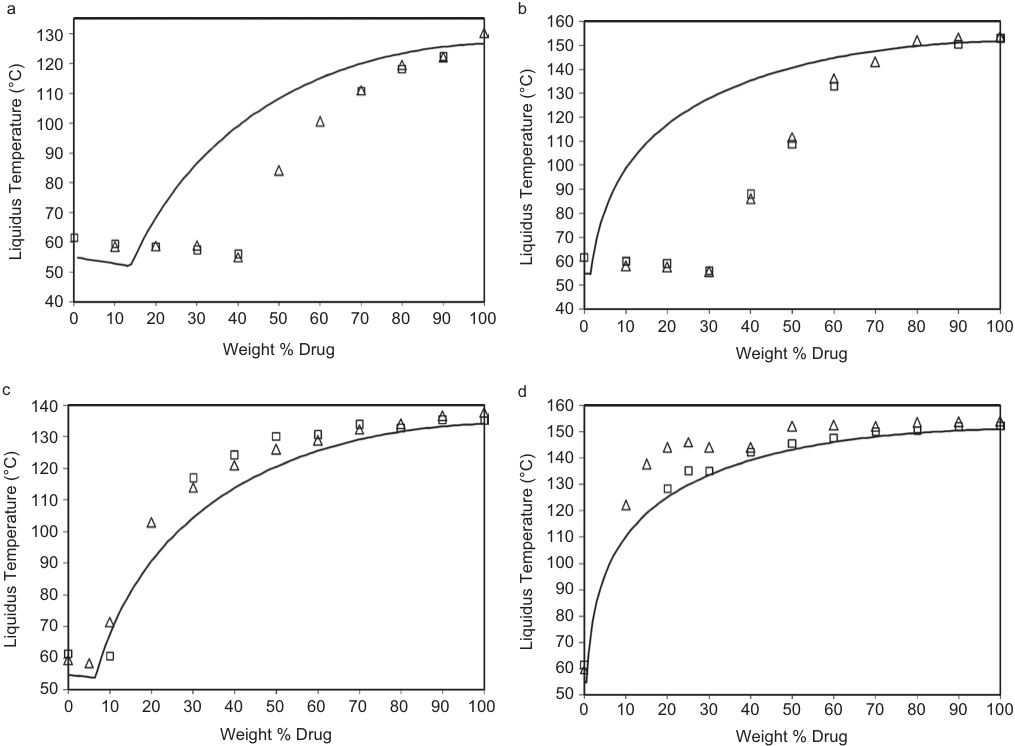
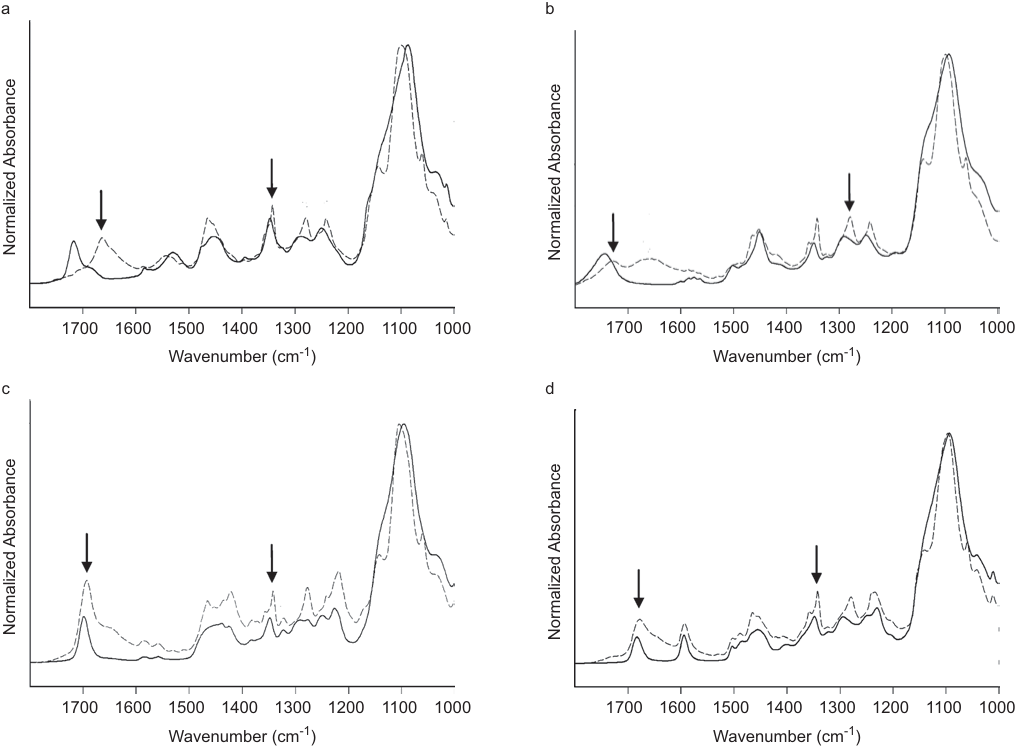
Panels (a) chlorpropamide and (b) aceclofenac lie far below the predicted line, while (c) loratadine and (d) haloperidol lie on or above it baird2011 R5, R6, R7, R8.
Why
Baird and Taylor write that a drug's solubility in molten polymer depends mainly on crystal lattice energy and on specific drug–polymer interactions, so weak lattices or strong interactions "would be expected" to give high eutectics baird2011 C10. The four highest are drugs that the authors describe as carrying hydrogen-bond donors that can interact with the PEG ether oxygen baird2011 M1, M2, C30; zhu2011 C9. (synthesis: a donor group is not sufficient, since haloperidol has an OH group but is monotectic baird2011 M4, R10, C32.)
Limits and transfer
PEG 3350 only; eutectics were read from 5–10 wt% grids, and hot-stage and DSC liquidus values differ by up to about 16 °C baird2011 X9, X7. For a new drug, measure the liquidus from 0 to 100 wt% by hot stage at 1 °C/min with steps finer than 10 wt% near the expected eutectic, and treat the result as an upper limit at roughly 50–58 °C, not as a storage-temperature solubility (F4) baird2011 P1, P2, P3.
How it was shown
Baird and Taylor (2011) made fused dispersions of chlorpropamide, aceclofenac, loratadine or haloperidol with PEG 3350: 500 mg physical mixtures were melted on a hot plate, cooled slowly, ground and stored over P2O5 for 24 h, in 10 wt% steps from 0 to 100 wt% drug, with extra points at 5 wt% (loratadine) and 15 and 25 wt% (haloperidol) baird2011 P1, A2. They read the offset of melting in hermetic DSC pans at 1 °C/min and, separately, the temperature at which the last solid particle melted by hot-stage microscopy at 1 °C/min, 2–3 mg per sample baird2011 P2, P3. Zhu and co-workers (2011) used the hot-stage method at 1 °C/min on benzocaine, ibuprofen, nilutamide and ketoconazole with PEG 3350, mixtures stored a few days and lightly ground, with DSC only as a check for ibuprofen; their chlorpropamide and haloperidol diagrams were taken from Baird and Taylor zhu2011 P3, P4, R19, R5. Zhu and co-workers (2012) added fenofibrate, by the same two methods, in the supporting information zhu2012 P9, P10, R24.
What the data show
The measured eutectic or monotectic composition is given for each system in the table below. Near the eutectic a single endotherm appeared below both pure melting points, and away from it two endotherms, a low-temperature one from the eutectic or monotectic composition and a high-temperature one from excess PEG or drug baird2011 R4, C13. In haloperidol–PEG the PEG melting stayed near 59–61 °C and the liquidus rose steeply from 10 wt%; in chlorpropamide–PEG the liquidus stayed at about 55–60 °C from 10 to 40 wt% drug and in aceclofenac–PEG from 10 to 30 wt% baird2011 R5, R6, R8. The chlorpropamide value of 35 wt% was not a tested composition, since the lowest liquidus lay at 40 wt% baird2011 X9, R5.e. For benzocaine, ibuprofen and nilutamide the eutectic temperatures were 48.9, 49.6 and 58.4 °C, and chlorpropamide's was 55.0 °C zhu2011 R5.b, R5.d, R5.e, R5.c. Ketoconazole was monotectic, with its liquidus at about 101 °C already at 5 wt% drug zhu2011 R4.b, R5.f. Fenofibrate's liquidus fell from about 82.4 °C for the pure drug to about 58.0 °C at 15 and 20 wt% and rose again toward about 60.5 °C for PEG, so the 20/80 dispersion lay at the eutectic composition zhu2012 R24.o, R24.c, R24.d, R24.a, C40. The low-temperature endotherm of the chlorpropamide and aceclofenac dispersions drifted to about 39–49 °C in the drug-rich traces, which a simple eutectic would not show, so their eutectic temperatures are not established by those traces baird2011 R4, X8.
| paper | system | method and conditions | result | ids |
|---|---|---|---|---|
| baird2011 | chlorpropamide–PEG 3350 (drug Tm 126.7 °C) | fused, DSC and hot stage, 1 °C/min | eutectic 35 wt% (not a tested composition) | R1.a, M1, X9 |
| baird2011 | aceclofenac–PEG 3350 (Tm 151.7 °C) | as above | eutectic 30 wt% | R1.b, M2 |
| baird2011 | loratadine–PEG 3350 (Tm 135.3 °C) | as above | eutectic about 5 wt% | R1.c, M3 |
| baird2011 | haloperidol–PEG 3350 (Tm 150.9 °C) | as above | below 1 wt%, monotectic | R1.d, M4, C14 |
| zhu2011 | benzocaine–PEG 3350 (pure drug 92 °C) | hot stage, 1 °C/min | eutectic 30 wt% at 48.9 °C | R5.b, R1.t |
| zhu2011 | ibuprofen–PEG 3350 (pure drug about 77.5 °C) | as above, DSC check | eutectic 40 wt% at 49.6 °C | R5.d, R2.t, R19 |
| zhu2011 | nilutamide–PEG 3350 (pure drug about 160 °C) | as above | eutectic 10 wt% at 58.4 °C | R5.e, R3.t |
| zhu2011 | ketoconazole–PEG 3350 (pure drug about 156 °C) | as above | monotectic | R5.f, R4.t |
| zhu2011 | chlorpropamide; haloperidol | phase diagrams cited from baird2011 | 35 wt% at 55.0 °C; monotectic | R5.c, R5.a |
| zhu2012 | fenofibrate–PEG 3350 (pure drug about 82.4 °C) | CPOM and DSC, 1 °C/min (SI) | eutectic minimum about 58 °C at 15–20 wt% | R24.c, R24.d, R24.o, C48 |
Figure
Panels (a) chlorpropamide and (b) aceclofenac lie far below the predicted line between 20 and 60 wt% drug, while (c) loratadine and (d) haloperidol lie on or above it; squares are DSC offsets and triangles hot-stage values baird2011 R5, R6, R7, R8.
Why
Baird and Taylor define a eutectic dispersion as one in which the drug dissolves appreciably in the molten polymer and the eutectic point is the maximum drug solubility in the molten polymer at the eutectic temperature, against a monotectic system in which the drug barely dissolves and hardly lowers the PEG melting point baird2011 C1. They write that a drug's solubility in molten polymer depends mainly on the crystal lattice energy (melting point and heat of fusion) and on the strength of specific drug–polymer interactions relative to the pure liquids, so that weak lattices or strong interactions "would be expected" to give high eutectic compositions baird2011 C10. Zhu and co-workers repeat this, as described "previously", for their drugs zhu2011 C4. For the proposed interaction they point to hydrogen-bond donors: benzocaine, chlorpropamide and ibuprofen carry donors that can interact with the PEG ether oxygen and have moderate melting points, whereas nilutamide's lower solubility "can be explained by" its higher melting point zhu2011 C9, C12. Baird and Taylor consider it "likely" that the drug donates a hydrogen bond to the abundant ether oxygens of PEG (about 75 per chain against 2 hydroxyl end groups) baird2011 C30, R12. (synthesis: nilutamide and haloperidol show that a donor group is not sufficient: nilutamide, which the authors count among the interacting drugs, reaches only 10 wt%, and haloperidol, which has an OH group, is monotectic with no carbonyl shift zhu2011 R5.e, C12; baird2011 M4, R10, C32; the lattice term in F2 is the other half of the explanation.) A lower-melting drug without donors reached an intermediate eutectic: fenofibrate, with no sign of hydrogen bonding to PEG, has a eutectic at 15–20 wt% zhu2012 R24, R25, C49.
Conditions and limits
PEG 3350 only; fused and slowly cooled dispersions; eutectic compositions on a 5–10 wt% grid baird2011 X9. DSC and hot-stage liquidus values differ by up to about 16 °C at some compositions (haloperidol at 20 wt%: about 128 against 144 °C by DSC and hot stage) baird2011 X7, R8.d. The crystal forms of the drugs as received and after fusion are not stated, and pure chlorpropamide shows an extra event at about 121–122 °C before melting baird2011 X14, R4. Different PEG grades, cooling histories and drug loadings above the eutectic were not studied. The neat PEG 3350 melts at about 60.5 °C in the phase diagrams, against 55 °C used as a model input baird2011 R4, M5, X10.
Counterexamples and conflicts
None found in the library for the existence of the spread. Donor groups do not predict the eutectic alone (see the synthesis note above). The text of Zhu and co-workers says DSC confirmed the benzocaine, nilutamide and ketoconazole diagrams, but only the ibuprofen thermograms are shown zhu2011 C5, R19.
Transfer check
For a new drug in PEG 3350, record the drug's melting point and heat of fusion and list its hydrogen-bond donor groups. Then measure the liquidus from 0 to 100 wt% by hot-stage microscopy at 1 °C/min on ground, fused samples, with steps finer than 10 wt% near the expected eutectic and with DSC as a second method baird2011 P1, P2, P3. A drug that melts above about 100 °C and has no donors should be expected to give only a few wt% (F2). Treat the eutectic composition as an upper limit at the eutectic temperature of roughly 50–58 °C, not as a storage-temperature solubility (F4).
History
Baird and Taylor (2011) measured the first four phase diagrams and tied the eutectic to lattice energy and interaction baird2011 C10, C36. Zhu and co-workers (2011) added benzocaine, ibuprofen, nilutamide and ketoconazole and took the other two from Baird and Taylor zhu2011 R5, C3. Zhu and co-workers (2012) added fenofibrate and concluded that haloperidol–PEG is the only monotectic system among their four zhu2012 C40.