Topic 1What precipitates from a supersaturated solution and how fast1 of 7
A drug precipitated by a pH change forms either crystals within minutes or an amorphous solid that maintains a high concentration.
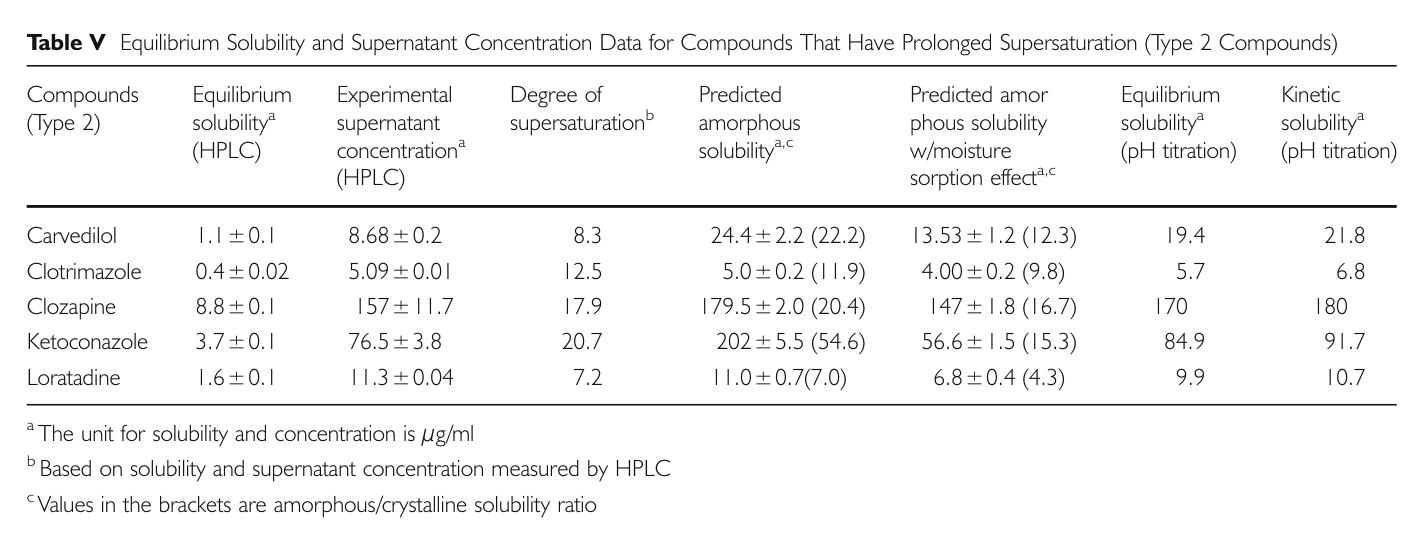
Dissolve a weak base in acid, then raise the pH until it precipitates. Five of ten bases formed birefringent crystals and their supersaturation (the concentration in excess of the crystalline solubility) lasted only 3.1–14.7 min; the other five formed a non-crystalline solid and stayed at 7.2–20.7 times the crystalline solubility hsieh2012 R1, R5, R10.
strongStrong for the ten bases, where solution behaviour and solid form matched every time, but full solid-state data were shown for only two of the ten precipitates hsieh2012 K1, X7.
Type 1 bases fall to the crystal level within minutes; type 2 bases hold a plateau far above it. hsieh2012 R2, R3, R5.b, R8, R10, R10.e; hsieh2014 R1.d, R3
For your drug
- Run a pH-shift test at the intended temperature and sample after 15, 30 and 60 min.
- Look at the solid under polarized light, and by PXRD or WAXS, within the hour: a fast fall with a birefringent solid is the crystal branch; a plateau several times above the crystal solubility with a non-birefringent solid is the amorphous branch.
How it works and key numbers
- Raising the pH turns the dissolved base into its neutral form, so the concentration of neutral drug suddenly exceeds the crystalline solubility hsieh2012 P4.
- Type 1: crystals need a certain supersaturation before they nucleate; once they appear, the concentration falls to the crystal solubility hsieh2012 C3, C21.
- Type 2: the authors "believe" the drug separates as a drug-rich liquid or glass, and the solution stays at that amorphous level, in metastable equilibrium with it hsieh2012 C34, C29.
- Their support: turbidity appeared close to the final level, the pH settled at once, and bases that are oils at room temperature behave as type 2; the separated phase itself was not seen hsieh2012 R13, C36, C37, C38, X20.
Evidence: data, conditions and papers
Finding F1. After a pH shift a weakly basic or acidic drug precipitates either as crystals that end its supersaturation within minutes or as an amorphous solid that holds a high plateau
In short. Ten weak bases precipitated by a pH rise at 37 °C fell into two groups that matched the solid they left behind in all ten cases. Five (bifonazole, dipyridamole, droperidol, papaverine, pyrimethamine) gave birefringent, crystalline precipitates after a supersaturation of 1.4–26.7 times the titration solubility that lasted 3.1–14.7 min. Five (carvedilol, clotrimazole, clozapine, ketoconazole, loratadine) gave non-birefringent precipitates with a glass transition at 28–56 °C and left a supernatant at 7.2–20.7 times the crystalline solubility hsieh2012 R1, R5, R10. In a second paper at 25 °C without polymer, dipyridamole, papaverine and warfarin spiked and fell within minutes, and glyburide held 4.5–5.3 µg/mL for about 18 min before crystallizing hsieh2014 R1, R3.
Type. observation in N systems (ten weak bases, then four ionizable drugs) Strength. for the match between solution behaviour and precipitate form in the ten bases, but solid-state data are shown for two of the ten precipitates [hsieh2012 K1: strong; X7].
How it was shown
Hsieh and co-workers (2012) dissolved ten weak bases at low pH in a titrator (37 °C, 0.15 M KCl) and added KOH until a UV/Vis probe detected turbidity (the CheqSol method); precipitates were checked for birefringence, by DSC and by PXRD hsieh2012 P4, C6, P5, P10. Hsieh, Box and Taylor (2014) ran the same titration without polymer on four drugs at 25 °C hsieh2014 P1, P3, P4.
What the data show
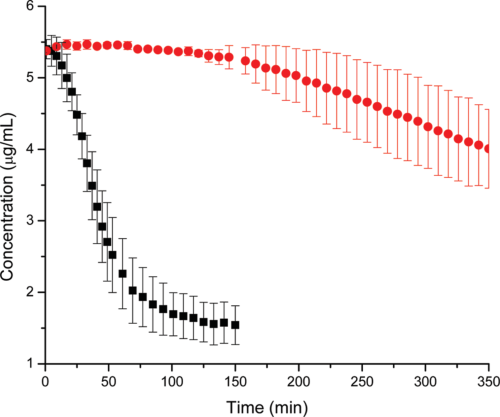
Dipyridamole (type 1) climbed to 71.3 µg/mL, fell to about 31 µg/mL within a minute and left birefringent needles, whereas loratadine (type 2) stayed at about 9.6–10.3 µg/mL to about 91 min against a crystalline solubility of 1.6 µg/mL hsieh2012 R2, R3, R11, R8, R10.e.
| drugs | conditions | result | ids |
|---|---|---|---|
| bifonazole, dipyridamole, droperidol, papaverine, pyrimethamine (type 1) | CheqSol titration, 37 °C | degree 1.4–26.7; duration 3.1–14.7 min; all birefringent and crystalline | hsieh2012 R1, R5 |
| carvedilol, clotrimazole, clozapine, ketoconazole, loratadine (type 2) | same, supernatant by HPLC | degree 7.2–20.7; non-birefringent, Tg 28–56 °C, amorphous by PXRD | hsieh2012 R1, R10 |
| dipyridamole, papaverine, warfarin, no polymer | titration, 25 °C | peaks about 84, 240, 165 µg/mL, gone within minutes; birefringent | hsieh2014 R1.a–c, R2 |
| glyburide, no polymer | titration, polarized light, 25 °C | plateau 4.5–5.3 µg/mL for about 18 min; birefringence from 30 min | hsieh2014 R1.d, R3 |
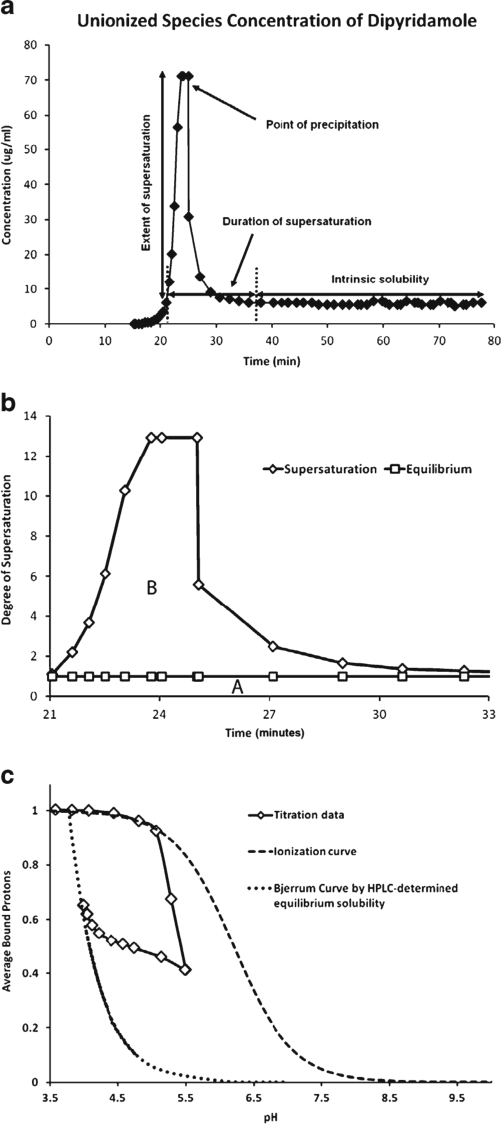
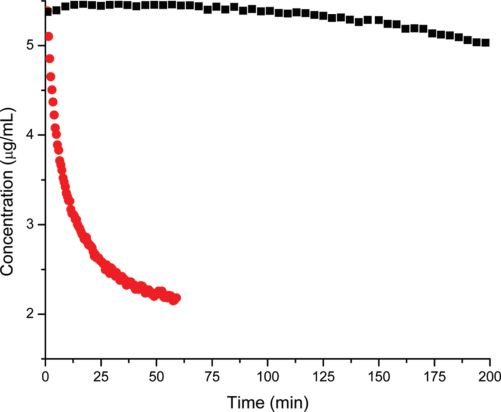
Panel (a) shows the neutral concentration peaking near 71 µg/mL and falling to the crystal level within about 15 min hsieh2012 R2, R4.
Why
The authors explain type 1 with classical nucleation: crystals need a certain supersaturation before they form, and the concentration then falls to the crystal solubility hsieh2012 C3, E7, E8, C21. For type 2 they "believe" liquid–liquid phase separation is the best explanation, the solution sitting in metastable equilibrium with a supercooled liquid or glass; that phase itself was not observed or sized hsieh2012 C34, C29, X20.
Limits and transfer
Solid-state data are shown for two of the ten precipitates, and the degree of supersaturation is defined differently for the two types hsieh2012 X7, R1, X3. Glyburide's plateau of about 18 min is close to the 14.7 min upper end of type 1 (synthesis: duration alone does not separate the branches, whereas precipitate form does) hsieh2014 R1.d, R3. For a new weak drug, run a pH-shift titration at the intended temperature, sample after 15, 30 and 60 min, and examine the solid by polarized light and PXRD or WAXS within the hour hsieh2012 P4, P5, P10; hsieh2014 P4.
How it was shown
Hsieh and co-workers (2012) dissolved each base at low pH in a Sirius GLpKa titrator (37 °C, 0.15 M KCl, nitrogen) and added 0.5 N KOH until a UV/Vis probe detected turbidity; small acid and base aliquots then moved the solution slightly sub- or supersaturated (the CheqSol method), and the neutral-species concentration was calculated from mass and charge balances. The kinetic solubility is the concentration where precipitation first appears, the equilibrium solubility the concentration at zero pH gradient hsieh2012 P4, C6. Precipitates were checked for birefringence, vacuum-dried for 24 h and run in DSC from −50 °C at 5 °C/min, and scaled-up (6- to 40-fold) precipitations were measured by PXRD within 1 h; crystalline solubility came from 72 h shake-flask runs at 37 °C and HPLC hsieh2012 P5, P6, P9, P10, P11. Hsieh, Box and Taylor (2014) ran the same titration without polymer for papaverine, dipyridamole, glyburide and warfarin at 25 °C (1 mg/mL drug in 0.15 M KCl, about 15 mg per run, replicate number not stated), then polarized light microscopy and synchrotron WAXS of the precipitate hsieh2014 P1, P3, P4.
What the data show
Type 1 example. Dipyridamole's neutral concentration climbed to 71.3 µg/mL at about 24–25 min, where turbidity appeared, fell to about 31 µg/mL within a minute and to 4.8–6.5 µg/mL from about 38 min; the peak was 12.5 times the titration equilibrium solubility of 5.7 µg/mL, the supersaturation lasted 14.7 min and the supersaturation factor was 4.6 hsieh2012 R2, R3, R5.b. The precipitate was birefringent needles melting at 165.92 °C onset (53.72 J/g) with PXRD peaks at the reference positions hsieh2012 R11. Type 2 example. Loratadine's concentration rose to 10.7 µg/mL at about 19 min, then stayed at about 9.6–10.3 µg/mL to about 91 min against a crystalline solubility of 1.6 µg/mL; its Bjerrum data followed the curve for 11.3 µg/mL, the HPLC supernatant, from the first point after precipitation hsieh2012 R8, R9, R10.e. The precipitate was non-birefringent with a Tg step from 24.28 to 32.51 °C, a crystallization exotherm near 93 °C on heating and an X-ray halo hsieh2012 R12. After a small KOH aliquot dipyridamole's pH was still falling 150 s later, whereas loratadine's settled at once hsieh2012 R6, R7. Without polymer at 25 °C, dipyridamole peaked at about 84 µg/mL near 15 min and was down to about 5 µg/mL by about 25 min, papaverine peaked at about 240 µg/mL near 16 min and remained near 15 µg/mL from about 18 min, and warfarin peaked at about 165 µg/mL at 19–20 min, fell to about 12 µg/mL at 22 min and stayed near 8 µg/mL thereafter hsieh2014 R1.a–c. Glyburide behaved differently: it peaked at only about 6.5 µg/mL at about 30 min, held 4.5–5.3 µg/mL for about 18 min, fell to about 0.6 µg/mL at about 48 min and 0.2–0.3 µg/mL afterwards; its precipitate was round, non-birefringent aggregates at 15 min and birefringent from 30 min hsieh2014 R1.d, R2, R3. Concentrations measured about 1 h after precipitation were at or below crystalline solubility for all four drugs without polymer (papaverine 9.5 against 12.2, dipyridamole 3.4 against 5.4, glyburide 0.2 against 0.2, warfarin 3.7 against 3.7 µg/mL) hsieh2014 R4.a, R4.k, R4.u, R4.ae.
| paper | system | method and conditions | result | ids |
|---|---|---|---|---|
| hsieh2012 | bifonazole, dipyridamole, droperidol, papaverine, pyrimethamine (type 1) | CheqSol titration, 37 °C, 0.15 M KCl | kinetic solubility 0.8–82.0 µg/mL against titration equilibrium 0.3–25.4; degree 1.4–26.7; duration 3.1–14.7 min; supersaturation factor 2.8–12.9; all birefringent and crystalline | R1, R5 |
| hsieh2012 | carvedilol, clotrimazole, clozapine, ketoconazole, loratadine (type 2) | same, supernatant after ultracentrifugation, HPLC | supernatant 8.68, 5.09, 157, 76.5, 11.3 µg/mL against crystalline 1.1, 0.4, 8.8, 3.7, 1.6; degree 7.2–20.7; all non-birefringent, Tg 28–56 °C, amorphous by PXRD | R1, R10 |
| hsieh2012 | dipyridamole against loratadine | pH after one KOH aliquot, dpH/dt | pH still falling at 150 s against settled; gradient swings to about −0.04 against about 0 | R6, R7 |
| hsieh2014 | dipyridamole, papaverine, warfarin, no polymer, 25 °C | CheqSol titration | peaks about 84, 240, 165 µg/mL, gone within minutes; birefringent | R1.a–c, R2 |
| hsieh2014 | glyburide, no polymer, 25 °C | titration, polarized light | plateau 4.5–5.3 µg/mL for about 18 min; birefringence from 30 min | R1.d, R3 |
Figure
Panel (a) shows the neutral concentration peaking near 71 µg/mL and falling to the crystal level within about 15 min; panel (c) shows the Bjerrum data leaving the ionization curve and moving to the crystal-solubility curve hsieh2012 R2, R4.
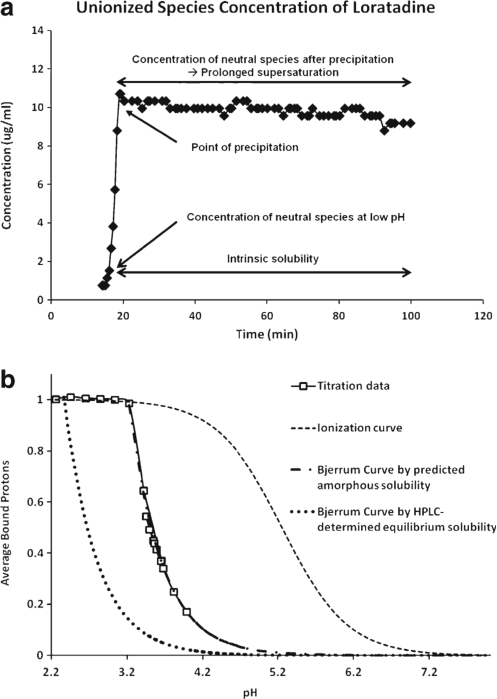
Panel (a) shows the concentration jumping to about 10.7 µg/mL and staying near 10 µg/mL; panel (b) shows the data lying on the curve for 11.3 µg/mL, far from the crystal-solubility curve hsieh2012 R8, R9.
Why
Hsieh and co-workers explain type 1 behaviour with classical nucleation: crystals need a certain supersaturation before they form, and the concentration then falls to the crystal solubility (J \propto \exp(-\Delta G^{*}/k_B T) with \Delta G^{*} \propto 1/(\ln S)^{2}) hsieh2012 C3, E7, E8, C21. For type 2 they "believe" liquid–liquid phase separation is the best explanation: the separating phase is a supercooled liquid or a glass below the crystal melting point, the solution reaches the amorphous solubility and sits in metastable equilibrium with it hsieh2012 C34, C29. Their support is that turbidity appeared close to the final concentration, the very small metastable zone expected of liquid–liquid separation, that the pH responds instantly, which they read as a very low barrier for exchange between the phases, and that bases which are oils at room temperature (amitriptyline, chlorpromazine, desipramine, fluoxetine, pramoxine) behave as type 2 hsieh2012 R13, C36, C37, R17, C38. The phase itself was not observed, sized or analysed for water hsieh2012 C34, X20. Hsieh and co-workers (2014) read the glyburide plateau as an amorphous stage that lasted about 20 min before crystallization brought the concentration to equilibrium, and found the other three drugs crystallizing within about 15 min hsieh2014 C6, C7, C14. (synthesis: the 2012 and 2014 papers use the same titration, so the glyburide plateau is a fifth, shorter-lived example of the amorphous branch; its 18 min is close to the 14.7 min upper end of the type 1 supersaturation, which shows that duration alone does not separate the branches, whereas precipitate form does.)
Conditions and limits
Both studies used 0.15 M KCl without polymer, at 37 °C (2012) or 25 °C (2014); titration amounts and replicate numbers are not printed, and the duration of supersaturation has no stated start and end criterion hsieh2012 P4, X13, X5; hsieh2014 P1. Solid-state data (PLM, DSC, PXRD with references) are shown for dipyridamole and loratadine only; for the other eight precipitates Table I gives "crystalline" or "amorphous" and birefringence hsieh2012 X7, R1. The degree of supersaturation is defined differently for the two types (peak over titration solubility for type 1; supernatant over HPLC crystalline solubility for type 2), so the two ranges are not on one scale hsieh2012 X3. The 2014 birefringence column has no stated observation time, and WAXS patterns are shown for 8 of the 40 systems of that paper hsieh2014 X3, X14. Precipitate Tg values were measured on vacuum-dried precipitates of unstated water content, so they are not dry-glass values hsieh2012 X20.
Counterexamples and conflicts
No base in the 2012 set broke the match between solution type and precipitate form. The 2014 paper's conclusion that crystals formed within about 15 min "in all cases" does not hold for glyburide, which was non-birefringent at 15 min and had a titration plateau of about 18 min hsieh2014 X2, R3. Some concentrations after precipitation lie below the crystalline solubility (dipyridamole 3.4 against 5.4 µg/mL), which the paper does not discuss; solubility was measured in other buffers over 72 h hsieh2014 X8. The type labels are not tied to crystallization class from the melt: class III covers all five type 2 bases and also three of the four classifiable type 1 bases hsieh2012 X1 (see Crystallization tendency F18).
Transfer check
For a new weak drug, run a pH-shift titration or a rapid pH jump at the intended temperature, record the peak and the concentration after 15, 30 and 60 min, and examine the solid by polarized light and, if possible, PXRD or WAXS within the hour hsieh2012 P4, P5, P10; hsieh2014 P4. Behaviour like type 1 is a fast fall to the crystalline solubility within about 15 min with a birefringent solid; behaviour like type 2 is a concentration that stays at several times the crystalline solubility for an hour or more with a non-birefringent solid hsieh2012 R5, R10. A drug whose solid is amorphous but whose concentration falls within 20–30 min, as glyburide did, is in between and needs a time-resolved solid-state read-out hsieh2014 R1.d, R3.
History
Hsieh and co-workers (2012) first linked CheqSol "chaser" and "non-chaser" behaviour (Box 2006, outside the library) to the form of the precipitate for ten bases hsieh2012 C4, C7, C20. Hsieh, Box and Taylor (2014) extended the titration to two acids and two more bases with synchrotron WAXS and added the question of polymers (F16) hsieh2014 C1. The chapter on amorphous solubility and LLPS continues from here: it follows the LLPS concentration of weak bases against pH (see Amorphous solubility and LLPS F10) and a weak-base salt shifted from gastric to intestinal pH (see F23).